

Notes From Nashville
Or, Thoughts from the First Conference on Contemporary Praise and Worship

A couple of weeks ago I attended one of the best conferences I’ve ever been to, academic or otherwise. Worship Leader Research’s Conference on Contemporary Praise and Worship was a gathering of scholars, practitioners, industry insiders, and church leaders to discuss this thing we all are connected to called “Contemporary Praise and Worship” (CPW).

It is the kind of academic space I have been searching for in the last 3-4 years, a space where we are all curious about the same kinds of questions about this very modern worship practice and what its role has been, is, and should be in the church in the 21st century.
I’ve been able to connect with people I’ve only met online as well as meet dozens of exemplary thinkers and practitioners who have, in a sense, helped assure me that my own musings on the church and the industry are not unworthy subjects for exploration.
As I’ve been reflecting on the conference, a few thoughts and questions have begun to emerge as I consider (for whatever it’s worth) what to make of this burgeoning community.
So here I’ve put together just a few of the big questions I have in reflecting on our time together…
1. The study of “Contemporary Praise and Worship” is a massive task…this is only the beginning
The nature of this conference was interdisciplinary, meaning scholars from diverse academic backgrounds and training, as well as practitioners, were all speaking from their perspective. It wasn’t just a room of theologians; there were musicologists, historians, sociologists, philosophers, journalists, worship leaders, pastors, and more. What stood out to me was how much there is to consider on the topic and how each discipline’s expertise sheds new light from a new angle on this thing we are trying to understand.
The announcement of the new peer-reviewed “Journal of Praise and Worship” is a welcome space for continuing this massive task from multiple angles. I’m excited to see how continued thinking and understanding about CPW develops in the coming decades through this unique community now that there will be a central place for the conversation to continue!
2. Who was (and wasn’t) in the room
A few observations on the socio-economic demographics of the conference.
My wife will tell you, I’m terrible at estimating the ages of people I meet, whether they are 5 or 500, so take this with a grain of salt, but I am fairly certain there were not many people in attendance at this event over the age of 50. This isn’t an evaluative statement, just an observation, but one I think is interesting for continued study.
This subject means so much to people. It matters in particular for people of a certain generation. That isn’t to say other scholars aren’t also interested, but it is clear that Christian music, and Christian Worship Music more specifically, has had a larger impact on those under 50 because of the time in which it was most prominent. This means, to me at least, that those who wish to speak to the phenomenon of CPW are those who have been shaped by CPW at its height. We are trying to understand a part of our own formation.
Additionally, this was a predominantly white, middle-class gathering of scholars and practitioners. When we talk about “worship music” in this space, we have to remember we are talking about a very particular segment of the American church that has been impacted by this music and is curious about this music.
When we examine the “worship industry” and CPW, we are examining a predominantly white middle-class phenomenon. This means there will be particular assumptions about words like “church” and “worship” and “music” in spaces like this that might be different in other spaces. Not out of any exclusionary practice, but out of the reality that CPW has generally impacted a particular social demographic.
While we’re on the note of social demographics, I think another broad point to emphasize here is that we were only able to gather around this phenomenon in the first place because it is a cultural phenomenon that has been economically viable. Belmont University, our generous hosts, has a whole Worship Arts program; many gathered were from institutions that have the same, and we were all talking about the Lilly Endowment grants that many institutions and denominations (including ours) have received for worship-related projects in the contemporary praise and worship space.
We were able to gather around this topic because there is an immense amount of money being moved around this subject in one way or another. A political economy of sorts always develops or is assumed when these kinds of systems are created. I think it is important to remember who gets left out or is naturally missed because there is no market to “tap into” when these kinds of economic structures develop.
This is not to say the conference was leaving anyone out; I just find it interesting to see who gets to be in “the room where it happens,” and who is naturally not in the room because of various socio-economic realities. These realities will impact how this community of scholars will and will not collaborate on the issues at hand.
3. The “Industry” Needs Clarity
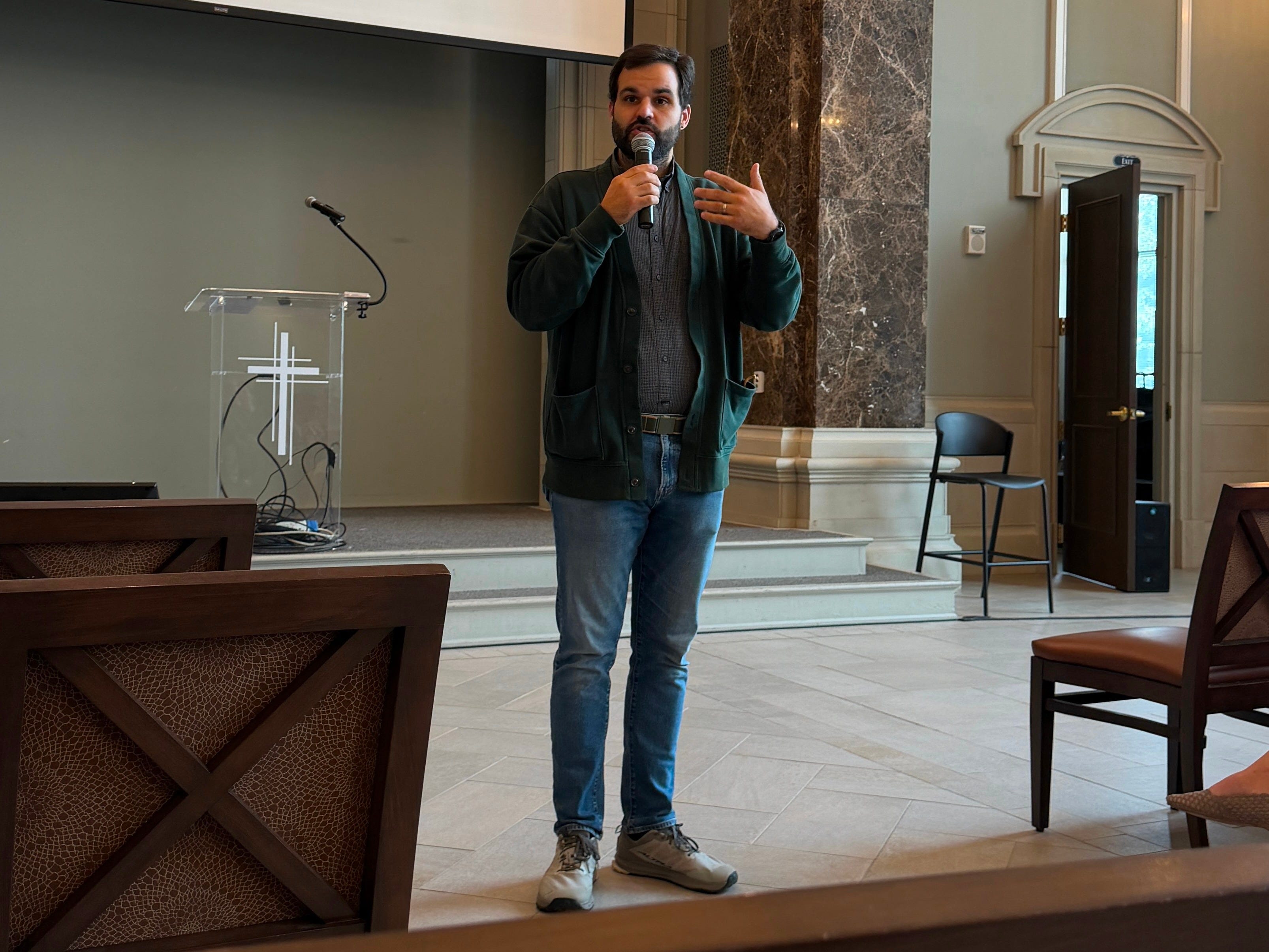
The part of the conference I’m still pondering the most is the roundtable discussion we had with veteran CCM/CPW industry executives. What stood out in particular is the need for clarity on various definitions, categories, and an understanding of what it is the “industry” does and doesn’t do.
First, I asked how they define the term “industry,” which had already been thrown around by all of us at least 50 times within the first hour of the conference. I wanted to understand what they have in mind when they use that word, as it may be different from my own use. They listed a number of key people and organizations they saw as part of the “industry”: artists, songwriters, management, labels, publishers, marketers, tour management, studios, producers, etc. Notably, and perhaps unintentionally, they didn’t mention churches, who are the market for the worship songs they produce, as well as a huge source of revenue through CCLI and other reporting agencies. There is a sense in which they are aware they are writing for the church,1 but there is another sense in which they claim to be trying to write for anyone and everyone and don’t want to be limited by the church. It just seemed a bit blurry to me.
Second, and related to this, I noticed throughout the conversation a blurred distinction between Contemporary Christian Music (CCM) and Contemporary Praise and Worship (CPW). They share many overlapping features musically, but there are definitely songs geared towards the church to sing in its worship practice and others that are geared towards listening enjoyment, but these industry leaders talked about these spaces interchangeably. It’s possible they were simply not being as precise with their terms as academics would like. Though it seemed to me from their answers that these executives did not see a distinction between music for church and music for general listening.
This is something I think has the potential to be a bit problematic. If they are writing for the church, there should perhaps be more precise thinking around serving the church with songs written for the church. Yet, my cynical self isn’t sure they particularly care; they just want the songs to sell wherever that may be. Either way, it is clear there is a need for a more thoughtful distinction between Christian songs in general and songs that are meant for the church’s worship practice.
This leads to a third note on the blurriness of all of this. My friend Kenny Klinglesmith asked a great question about how labels go about filtering the theology of songs and if Christian maturity of artists that are writing and performing these songs plays a significant role. Using a made-up example of a country artist who wanted to crossover and write a song about Jesus even if they weren’t a Christian; he was curious: what would they do with that?
There was a range of answers on this from the panel. The most charitable answer of the bunch amounted to a desire to be discerning while also hesitating to tell someone who did not grow up in a Christian space that they aren’t qualified to talk about Jesus. They wouldn’t want the Christian music industry to live inside a “whitewashed box.”
There is much to appreciate about their humble posture here. But at the same time, they have claimed to be writing songs for the church. In doing so, they are claiming a formative role in the life of the church’s worship practice while simultaneously resisting being theological gatekeepers.
It is hard for me to see how one could claim both. If one is writing “for the church,” some kind of theological gatekeeping must be happening. If so, the answers are a bit disingenuous. If they aren’t theologically gatekeeping, they are irresponsible.
The point of all this isn’t a “gotcha” moment but just to point out that there is clearly some fuzzy category confusion inside the industry. If this is the case inside the industry, then no wonder we who are pastors and worship leaders are wrestling with whether to use certain songs or not. It probably also means we need to do better not to assume there is a thoughtful, theological framework behind the songs that are platformed.
4. What happens when we center the “phenomenon”?
The description of this conference by the organizers said that the conference was not focused on a particular academic discipline but one that “centered the phenomenon itself.” I have been wondering what we gain when we do that, but also what we lose?
We obviously gain a whole host of perspectives and insights that would not be available if this were strictly a theological or an artistic consideration of CPW. The gains of thinking historically, journalistically, practically, theologically, ethically, and so on all help us get a new understanding, as I’ve already mentioned.
The biggest question that has been swirling in my head since the conference is: what do we lose when we center the phenomenon itself?
Or perhaps a better question: what kind of assumptions does each discipline bring to the table to look at the phenomenon, and are all assumptions equal?
At the risk of this coming across as a bit of a power move - which I detest - I think the primary set of assumptions required to bring clarity to CPW must be centering its relationship to the Church. Not out of any sense of self-importance as a pastor or a burgeoning theological thinker, but out of what I see as the core claims made by the phenomenon itself.
Contemporary Praise and Worship claims, at least implicitly, that it is for Christian Worship at most, and a pointing to Jesus Christ at the very least. My conviction is that Christian Worship and giving witness to who Jesus is cannot exist as ambiguous ideas that can arise from any place. Christian Worship can only arise from within the gathering of Christ followers called the Church.
We can certainly ask questions about how the music works sociologically, musicologically, economically, ethically, and so on (and we should). But further, I would also want to work from a starting assumption which understands that CPW is an outworking of embodied worshipping communities and only after that has the phenomenon become relevant to other disciplines. My two cents: if we miss that CPW exists first and foremost as/for worship practice, we won’t be able to make any lasting evaluations of the phenomenon nor bring any kind of clarity to the fuzziness in the industry and its relationship with the church.
Again, the conference was fabulous so this isn’t a knock on it, just my own reflection, and perhaps a tinge of caution, as these conversations continue to develop.
Overall, I cannot wait to attend again, and I hope the good folks at Worship Leader Research announce another conference soon!
Thanks for reading! I’m currently writing my Master’s Thesis at Northern Seminary where I’m exploring this complex relationship between the Worship “Industry” and the Church. If this kind of stuff interests you, subscribe for regular pieces on this topic as I keep digging deeper!
One executive even explicitly said part of their songwriting process is asking, “What does the church need to sing right now?”