

The Worship Industry Has a Church Problem
Observations from Leah Payne's 'God Gave Rock and Roll To You'


In preparation for writing my Master’s Thesis, I recently read Dr. Leah Payne’s God Gave Rock and Roll to You.
Payne provides a significant contribution towards understanding the phenomenon called “Contemporary Christian Music” by charting its historical roots in the church through to its growth within the political economy and ideology of the United States. (at least that is how I would describe it).
Additionally (and most significant for my research interests), one sees how CCM has slowly morphed into the Worship Industry over the last 25 years.
This won’t be a complete review of the book, but I wanted to make a few observations on the relationships between the Industry, the Church, power, and capitalism that I noticed while reading.
So here in no particular order…
1. CCM/Worship Industry has always been a tool for cultural influence in place of the church
After emerging from the revival tents of the Holiness movement, publishing houses for songs quickly developed. By the mid-20th century, evangelical conservatives recognized the power of music and media through radio, recordings, and later television and film, to mobilize a political and ideological base. This mobilization would have an overlap with Christian Holiness denominational convictions, but would most especially be in lock step with white, middle-class, suburban values (Chapters 1 & 2). In Payne’s narrative, one can see from the early days that the history of CCM is a particularly “white” demographic phenomenon and not necessarily representative of other cultures within the church in the United States.
CCM artists would frequently be involved in Republican party politics, RNC events, Presidential inaugurations, and other lobbying efforts. This can easily lead, and perhaps did lead, to many average churchgoers equating Christianity with Republican politics and politicians equating the church with the Worship Industry. For better or for worse, these CCM and Worship industry artists have become de facto ecclesial representatives. “When CCM stars appeared on Capitol Hill to urge lawmakers to forgive African debt,” Payne writes, “elected officials assumed they represented the thousands of fans who turned out to see them on the festival circuit” (154).
Like many others, I grew up in this milieu, and it took me quite a long time not only to recognize that there were Christians voting for both parties, but perhaps more accurately, that Christianity did not belong to any party. As a result, it might be safe to say that CCM has probably contributed quite a lot to the current political climate in the United States, and especially, the climate of conflict within evangelical Christianity.
2. Using partisan ideology and values as a business model was/is very lucrative
The use of CCM as a tool for cultural change also meant that the industry needed to cater to a particular ideological perspective. Catering to this base, especially in the 80s, 90s, and early 00s, was not difficult because it was extremely lucrative (130). A niche had been found among white, suburban moms (called “Beckys” by industry executives) who they could count on to purchase ideologically “safe” music for their kids. Into the peak CCM years, Disney and other huge corporations began to take notice and were tapping into this same base. Payne argues that Britney Spears and Jessica Simpson were cut from the same cloth as many CCM female pop stars in their Disney Channel days (141-145).
For all the Swifties out there, this meant that when Taylor Swift first came on the scene, it spelled certain doom for the CCM female pop-star who was writing similar tween/teen innocent lyrics that Christian moms felt were just as safe and friendly as CCM artists (145).
This raises questions for me. Does this mean that the CCM industry leaders were committed to the specific values their music seemed to promote, or did they, like Disney, see a market to make money? It seems like both might be true to a lesser or greater degree. Many were passionate about promoting various conservative causes, and others were cautious and less enthusiastic but knew where their bread was buttered. I wonder if there was less money in it, if the passionate promoters would have been quite as enthusiastic.
3. The noticeable absence of traditional Northeast cultural/power centers from the conversation
Being a New Englander now living in the NY/NJ region, I have always noticed the absence of “major” worship groups or movements coming from this region. I was pleased as punch that Payne explained why!
It seems to stem back to the early roots of CCM in the holiness revival meetings in mostly southern regions of the United States. These regions were without access to the publishing centers of New York, Boston, and Philadelphia, where hymnals and other material were printed. This led to the creation of Christian centers of publishing, first in Nashville and then later on the West Coast. The rather late comers on the West Coast were tied to the Jesus Movement, but Nashville, in particular, was and still is the hub for most of CCM and Worship music.1
On the practical side, this is simply where the work is, and if you are a musician, you go where the work is. But when it is music that is supposed to be for the church, generating all or most of what the church around the United States uses for its worship practice from one location might inadvertently promote a universalizing and homogenous version of Christian worship practice.
I’d argue it already has.
4. The Blurry Line Between Mammon and Mission
This observation alone probably deserves a post of its own. But here are three sub-point observations about this blurry distinction for now.
First, some artists and bands have done a better job than others of naming the distinction and ensuring they stay distinct, but most have not. And often those Christians in large middle-class, white majority churches are the ones driving the market of the industry and the ones who tend not to pay attention to the distinction between Industry and Church. One notable incident in the early days of CCM, Payne notes, is when Amy Grant’s Heart in Motion, a crossover album marketed to a secular audience, became a success. “Evangelical mass-media makers interpreted the success of Heart in Motion as a major victory in the war to win the nation for God” (90). Market success equaled mission success.
This leads directly into a second point: The Industry’s increasingly homogenous, white, male-dominated makeup is not a bug; it’s a feature of utilizing an unexamined political economy (145, 148-150). By political economy, I mean the way in which the economic structures of a nation-state give or restrict political power and agency to its inhabitants. The nature of CCM exists the way it does because it has taken up the unexamined music industry structures of a capitalist society that have existed in Europe and the United States for centuries. This political economic structure is highly racialized and patriarchal, meaning it has been set up to keep wealth (and therefore power) in the hands of white male European descendants.2
Because CCM/Worship Industry has taken this unexamined political economy as a given, it will automatically stratify and homogenize who runs it, influences it, and serves as its primary operators. This also means that it will homogenize its sound, ideology, and ethos, with token outliers (117-118).
Third, the universal claims come from the assumptions of a particular group of people holding all of the financial power/capital, which creates a feedback loop where more of the same kinds of people are drawn into the hierarchy of the industry and become the influential voices of that industry. This, in turn, draws more of the same kinds of people into the industry. To keep the industry financially viable, it can never shift too much in order to maintain its primary financial base, which now, in the “Worship age”, comes through CCLI income based on predominantly white, middle-class, Mega churches (82).
Finally, the financial gains (and losses) over the years to keep the industry afloat have meant a continual distancing of local churches and Christians from being in control of the actual CCM and Worship Labels they once helped launch. They’ve been sold and consolidated over the years into huge global corporate labels like Universal and Sony. To my knowledge, Integrity (owned by non-profit David C. Cook) is the only major worship label not owned by a secular corporation. This means that the Industry producing the music for the practice of worship in the local church is in some ways more distant from local churches than ever before (162).
5. The Cartesian Assumptions in the Industry’s Success Metrics
René Descartes’ famous claim, “I think, therefore I am,” brought about a mind-body disconnect where one needs only think or say something for it to be so. It is not necessarily tied to action or embodied living.
The confluence of culture wars, activism, and political economy that is subsumed within the framework of CCM/Worship Industry music and its artists is perhaps illustrated most succinctly in phrases such as “The name of Jesus was lifted up,” and “God was glorified.” Or as one industry executive put it, “We sold 700,000 copies of one record…700,000 souls reached for Christ” (90).
Throughout Payne’s book, there is a distinct sense that if one got a stadium full of people to say or sing the right words, to commit in a solemn moment, to raise their hand, to buy or listen to that worship song, then the gathering was authorized as “Christian.” If you got very influential political or cultural celebrities to be in that room or arena, or have these CCM and Worship artists visit halls of government, you were providing a Christian influence just by using the right words and having the right people in the same space.
From Billy Graham’s early recognition of the role music could play in his stadium events, to visits in the White House of multiple (primarily Republican) administrations, the entire Industry’s project was legitimized theologically and ecclesiologically simply by saying (or selling) the right words. Or as one Christian band explained, “‘Our yelling unintelligible lyrics was suddenly holy work,’ he remembered, ‘because the lyrics were Christian’” (1).

This approach to Christian mission assumes a Cartesian framework for how giving witness to Jesus’ Lordship works. If one gives intellectual assent to the name of Jesus or sings the name of Jesus in a song, or consumes media with Christian words, stories, or narratives, then God has been given the glory. It means we don’t actually need the church to embody the way of Jesus in the world as a witness of the Kingdom of God. (I’ll come back to this problem for the church in my conclusion).
This rationale, while extremely prevalent, is baffling to me. Jesus himself said:
“Not everyone who says to me, ‘Lord, Lord,’ will enter the kingdom of heaven, but only the one who does the will of my Father in heaven. On that day, many will say to me, ‘Lord, Lord, did we not prophesy in your name, and cast out demons in your name, and do many deeds of power in your name? Then I will declare to them, ‘I never knew you; go away from me, you evildoers' (Mt 7:21–23., NRSV).
Yet within this Cartesian framework, one understands words in themselves to carry the entirety of action.
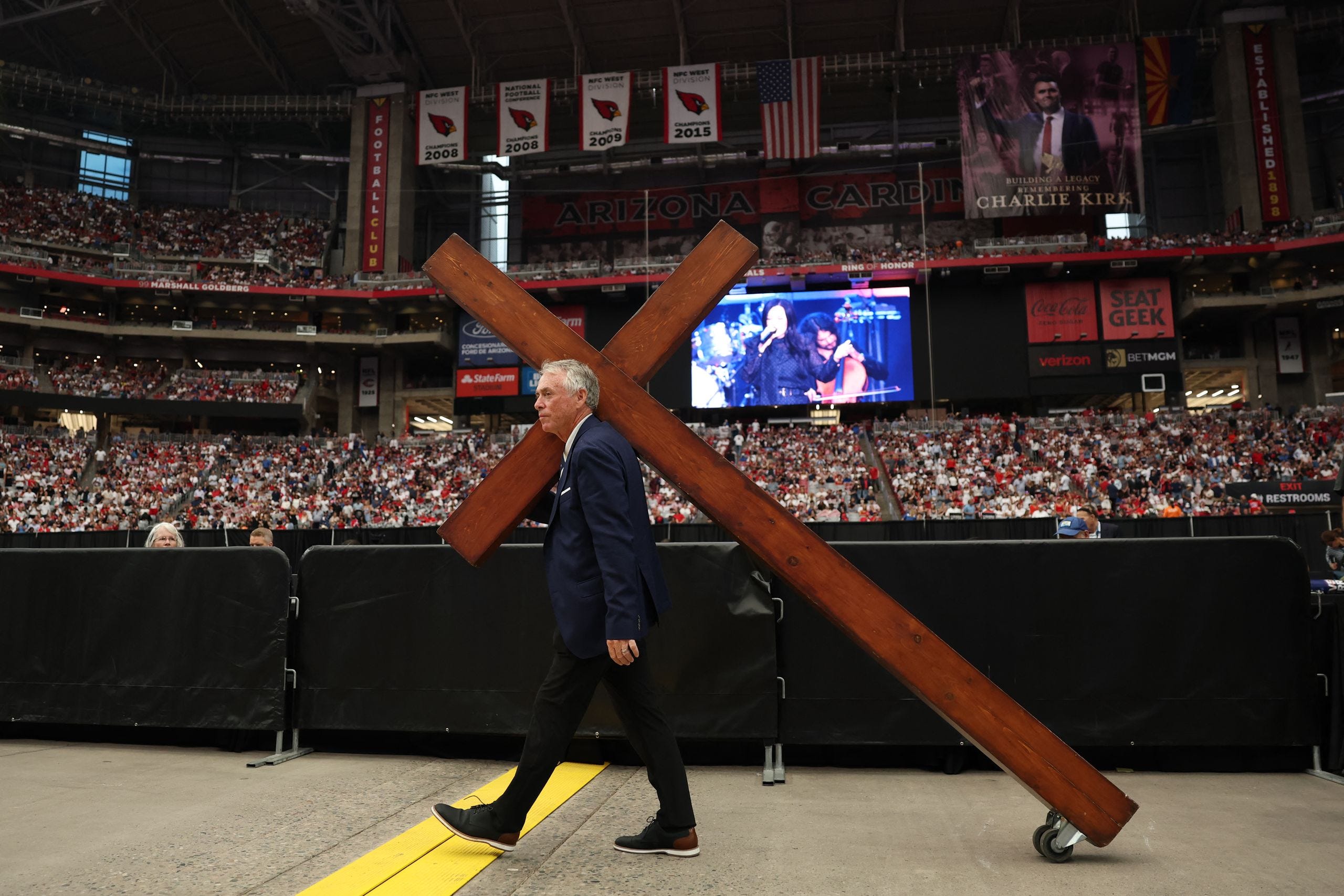
Many find it impressive when well-known worship artists “lift up the name of Jesus” in rooms filled with well-known political and cultural influencers. I am less impressed. While I don’t doubt the sincerity of some people in those spaces, the entire exercise serves as a kind of “Christ-washing” that allows for a mix of partisan politics and ideology to be involved with the cross of Jesus Christ. This emerges for me as one of the giant challenges from Payne’s book.
Conclusion
One takeaway that I find implicit in much of Payne’s narrative is that, functionally speaking, American Christians don’t believe in the church. It seems that many Christians believe in leveraging outside organizations, businesses, lobbying groups, and independent artists and ministries to leverage power in society. The church seems to function as little more than a consumer base for Christian media and a voting bloc to whom politicians appeal.3
Yet, Constance Cherry describes any kind of “worship” taking place outside of the context of a local congregation’s practice of gathering together weekly for communion, word, singing, prayer, and service, to be what she calls “para-worship” and thus derivative of the real thing.
I’m struck by how much the American Church has accepted feeding off of para-worship as if it were the real thing and as a result looks to para-worship (i.e., the Worship Industry) for its cues on what worship is, what the church is, and how they should or should not play a role in influencing culture/society. This is evident in the rise of the worship artist who could “deliver a worship experience with or without a specific congregation or preacher or any other trappings of liturgy” (128).
In ‘After Virtue’, the ethicist and philosopher, Alasdair MacIntyre, says that practices in a community contain “goods within themselves” that do not need any kind of external validity or verification in order to be legitimate and good. Yet what we see in Payne’s account is a church seeking validity for its worship practice in an outside entity (the Industry) in hopes of leveraging cultural influence. This grieves me. The American church is as confused as ever about its own ecclesial consciousness. We do not know where to turn for our self-understanding, and for some, this Industry and its artists have helped alleviate that problem.
I realize this feels like a bit of a gloom and doom ending. But it is not. It is only the beginning. A doctor cannot treat a patient until they diagnose the ailment. The same is true for the church in the United States. We must first diagnose our own ecclesial and liturgical history before we can rightly and faithfully course correct. Leah Payne offers us tools to do just that.
If you read this, thank you! This article, and more to follow, are feeding into my thinking as I write my Master’s Thesis. I want to continue to refine and craft my arguments, so please push back if you see things I’ve missed or have additional insight. I welcome your comments!
One anecdote to make this point that Payne does not mention in her book, but demonstrates how influential Nashville is for anyone who wants to be taken seriously in the industry, is that Bethel Music’s office is in Redding, CA, but they also now have an office in the Nashville area.
See, for instance, Jonathan Tran’s Asian Americans and the Spirit of Racial Capitalism or Malcolm Foley’s The Anti-Greed Gospel for more on political economy. On how power works, see David Fitch’s Reckoning With Power.
I’m going to have a lot more to say on this in the future. Suffice it to say now that I was recently pointed to an essay Dietrich Bonhoeffer wrote on his observations on the church in the United States and…well, wow. More to come.
Also, to add to your list if helpful, I’m churning through History of Contemporary Praise & Worship by Lester Ruth and Lim Swee Hong. It’s pretty academic and heavily historiographic but very insightful.
Dude… articles like this are why I love substack.
Somehow, the “algorithm” or whatever drives notes led me to you.
Such like-minded thoughts. And eery parallel timing. I’m in the middle of an essay series that I’m calling “Big Worship” and you are I are speaking the same language.
Keep going. This is worth writing on.
Subscribing to support.